

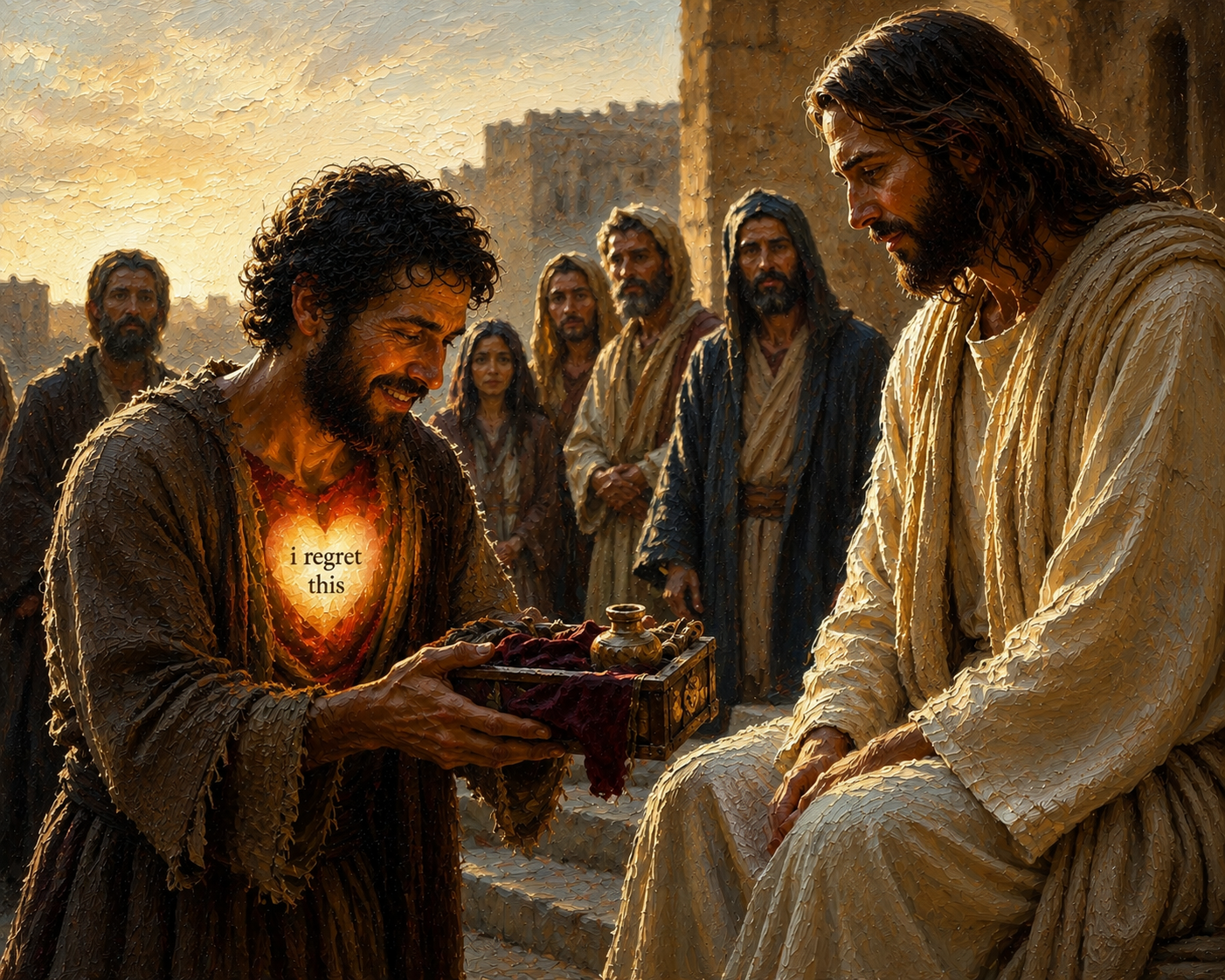
The Lord looks at the heart

God’s judgment of an action is inextricable from His reading of the heart behind it. Four distinct heart postures emerge across the biblical narrative, each concluding with a specific divine response:

The defiant heart — Ahab

He operated from hardened rebellion. Correction was systematically rejected. Cleverness is deployed in service of self-sovereignty against God’s declared will. This heart is not reachable through consequences because it has already foreclosed the channel of correction. Consequently, he was condemned.

The sincere but immature heart — Rebekah

Genuinely oriented toward God, yet not fully trusting the Promiser to fulfill what He has promised. The action is compromised not by wickedness but by anxiety and a lack of faith. This heart is reachable; consequences can do their sanctifying work. This type of heart can be corrected; however, repentance is required. The recognition that one acted from a lack of trust is itself a call to repentance, not a defense. Both Rebekah and Jacob allowed anxiety to justify manipulation, demonstrating that a person can be committed to a godly outcome while operating from an ungodly motive of self-reliance.

The heart being broken toward surrender — Jacob

Jacob had a heart that was genuine in its devotion, yet striving in its method. God does not abandon such a heart; He breaks it into full dependence. The limp he received was the mark of the blessing and transformation, showing that he had ceased fighting in his own strength.

The responsive heart — David

Though deeply flawed and guilty of severe transgressions, David possessed a heart that was instantly responsive to God’s correction. Upon confrontation by the prophet Nathan, he offered no self-defense, shift of blame, or rationalization, but immediate, transparent confession: “I have sinned against the Lord.”
This illustrates a heart completely yielded to divine scrutiny.

The Warning

“The heart is deceitful above all things and desperately sick — who can know it?” (Jeremiah 17:9)

The heart motive framework carries a danger that must be addressed: it can become the very mechanism by which self-deception operates. A person does something questionable and says: “God knows my heart — He knows I meant well.” This invokes interior motive as a shield against external accountability.

The same verse that establishes God’s heart-reading capacity establishes that the human heart is not a reliable self-reporter. Ahab almost certainly believed his own motives were reasonable. Most people acting from hardened hearts do not experience themselves as defiant; they experience themselves as misunderstood, pragmatic, or simply doing what was necessary.

The Importance of motive

Though overlooked, motive matters more than our actions do.
Esau married Hittite women however later married a daughter of Ishmael to please his parents. His action was tainted by his impure motive. He acted to please his parents, not the Lord who instructed against marrying foreign women.

“Do not eat the bread of a miser,
Nor desire his delicacies;
For as he thinks in his heart, so is he.
‘Eat and drink!’ he says to you,
But his heart is not with you.
The morsel you have eaten, you will vomit up,
And waste your pleasant words.” (Proverbs 23:6-8)

According to Gotquestions.org, this is what this scripture means:
According to most modern translations, the ninth saying of Solomon instructs seekers of wisdom to avoid greedily eating food served by a stingy man. Craving such a man’s delicacies is dangerous because his generosity is false. With a warm welcome, he says, “Eat and drink,” but his heart is not in it. He’s not glad to see you enjoying his fare; rather, he is watching every bite you take and calculating the cost the whole time.
Once you realize what your host is thinking, you’ll want to spit out your food because what seemed to be offered so freely was begrudgingly served. And all of your kind compliments and table talk was wasted. The penny-pinching host was not genuinely interested in sharing his bounty with you or listening to the conversation you shared as his guest. Everything you said fell on deaf ears, because he is the kind of man who is always “thinking/calculating in his heart.”

Because the human heart is an unreliable self-reporter, the ultimate biblical solution is not deeper self-analysis, but submission to the Lord’s heart surgery. As promised in Ezekiel 36:26, the Lord does not merely evaluate the sick heart; He replaces it, exchanging a stubborn heart of stone for a responsive heart of flesh.

Every man’s way is right in his own eyes, But the Lord weighs and examines the hearts [of people and their motives].
(Proverbs 21:2)

You may think everything you do is right, but the LORD judges your motives.( Proverbs 16:2)

In conclusion, the assessing of motives is a domain the Lord rules with absolute accuracy and we should be honest when we fall short in this area and not claim self-defense.


A desire is not validation nor is it endorsement

Scriptural references: (2 Samuel 7:1–17; 1 Chronicles 22)

David has a strong, sustained, desire to build God a house. He is grieved that he dwells in cedar while the ark dwells in a tent. Nathan initially endorses the desire: “Go, do all that is in your heart, for God is with you” (2 Samuel 7:3). David has the resources, the organizational capacity, the administrative infrastructure and  genuine devotion.

Surprisingly, God’s answer was no. It was not due to the desire being wrong or the temple being unnecessary but due to David’s history of bloodshed. Although imperetive for Israel’s security, it disqualified him for this particular assignment. The Prophet Nathan returned to correct what he had told him before.

What David’s Case Establishes

Every external marker said yes to David’s desire:

  • The desire was not impulsive
  • The desire was noble, godly, oriented towards God’s glory
  • The desire was initially prophetically confirmed
  • The man holding the desire was genuinely devoted
  • He had the wherewithal to execute this desire

Yet, God said not you. This means that no combination of duration, nobility, prophetic encouragement, personal devotion, and wherewithal constitutes divine authorization. All of those factors can be evident simultaneously and the answer can still be no, or not you or not yet — or this is accurate however I have someone else assigned to it. And the Lord did; that person was his son, Solomon. 

Therefore, a desire is not validation or endorsement; it is but data that requires submission and vetting by the Lord, not a conclusion to act upon.
David’s story also thwarts the teaching that all desires in our hearts are a signal from the Lord of our purpose or assignment and we are to pursue them.

David’s mature response

David did not argue nor did he invoke his pure intention. He sat before the Lord in (2 Samuel 7:18–29) and prayed “Who am I, O Lord God, and what is my house, that you have brought me this far?”

The Lord’s redirection

He received the no and he redirected his energy towards preparation rather than construction. He gathered materials, organized the Levitical orders, and handed Solomon everything that was required. Evidently, his love for the project did not disappear, rather, it was submitted and redirected into a form God could utilize.

Furthermore, in that season of submitted waiting, David wrote the Psalms, which became the prayer book of the entire people of God across three thousand years. Not being chosen to build the temple did not equate to rejection, he had his own assignment.

The Questions That Must Precede Action

  • A burning, sustained, recurring desire is worth paying significant attention to; it may be pointing toward something real. But the next step is not execution, the next step is examination. These are the questions that must be brought before God:
  • Lord, is this desire from You?
  • Is this Your assignment for me or is this a mere attraction to something good?
  • Is the timing now, or am I carrying something meant for a future season?
  • Am I the vessel for this, or am I called to prepare the ground for someone else?
  • Is a prophetic word or voice of correction being evaded in my pursuit of this?
  • David’s answer to those questions, had he asked them fully, would have been: the desire is from Me, the temple is real, but you are the preparer not the builder. That is not a rejection; it is a precise assignment within the larger purpose.

There lies heart-wrenching, detrimental repercussions in pursuing unsubmitted, unvetted desires

  • The enemy utilizes them to crush our faith. When we pursue what is not in God’s will for us to do or what we are not even gifted to do or undertake an assignment out of season, it may not prosper. That causes our faith to dwindle, giving the enemy room to work. We are then left feeling rejected and dismayed.
  • Individuals may not even partner in the good work we are doing, leaving us with a barrage of questions for the Lord
  • The enemy can also utilize it to displace faith with fear so that the faith required for this assignment 20 years from now will be absent.
  • Desire alone cannot sustain anyone where wisdom is required. The Lord may need to teach us how to operate in that assignment ahead of time, and the desire may be a signal of what lies ahead, not of what should be pursued now.
  • The early Apostles experienced this. They prayed for the epileptic boy and failed to get him delivered. Unbeknownst to them, that kind required prayer and fasting. Had they possessed this knowledge, their session would have yielded the desired result.
  • At times, assignments do not prosper due to this fact and individuals become despondent, forego it entirely, whereas the endeavor failed due to reasons stated above. The enemy spoils us of our purpose with this strategy. Do not be swift to discard what failed. It is time for us to reevaluate our steps and seek the Lord concerning these issues.

The heart

We are exhorted to guard our hearts for out of it flows the affairs of life (Prov 4:23).

The heart is the primary organ of communion with God; the faculty through which the believer knows, loves and responds to Him.
It is therefore no arbitrary target; the adversary directs his most sustained assault precisely here, seeking to disfigure and contort the believer’s perception of God. This is why the enemy aims to sever the connection we have with the Lord, utilizing our hearts as his target to accomplish his goal. He seeks to give us a distorted view of God- whether as indifferent, harsh, unreliable or as distant so that our hearts disengage from fellowship with Him.The consequence is a believer feeling that since the Lord is aloof and indifferent, they will cease seeking His face.

Questions to ask ourselves

  • Is my heart still seeing Him accurately?
  • Is my heart still responsive to Him?
  • Am I still making melodies to him in my heart? Lifting songs of praise and adoration with thanksgiving or have I permitted silence to inhabit the corridors of my heart?
  • Is my heart tender or has it grown callous due to my circumstances?
  • Does my heart genuinely love Him or is it seeking Him in a disengaged state?
  • Does my heart long for Him and seek to be satisfied by Him or are the pleasures of this world well able to satiate me?
  • Is my heart submitting to Him and His Word or do I still claim self-governance?
  • Do I seek for the meditations of my heart to be pleasing to Him?
  • Am I meditating on his Word?
  • What has my attention? Does the world have my focus more than His Word?
  • Am I guarding my heart from the influence of the world?
  • Is the Word still alive in my heart?
  • Do I still find His Word more edifying than my intellectual pursuits or entertainment?
  • Do the things of the Lord command my affection and attention with more urgency than the things of this realm?

Where the honest answers reveal deficiency, may we all not despair but turn. The Spirit who convicts is the same Spirit who restores.

What we give ourselves matters. We fail to realize that when we received salvation we were enlisted into a life of being transformed into the image of Christ. Thus, what we give our attention to will either contribute positively or negatively to that process. When we read the Word, the Holy Ghost transforms us. His light penetrates our hearts, for He sows the seed of the Word in our hearts. We can choke this seed by how we order our lives, thus stifling the potential of the Word that was planted. Furthermore, when we are taught about holiness and the preceding action we make is to watch a program that is contrary to what we just read, we display self-contradiction and either a lack of understanding or ignorance. We read about how the Lord says to get the filthy or foul language out of our mouths yet once we close our Bibles, we unwittingly watch a series that has characters incorporating foul language in their speech, surround ourselves with friends and listen to music that does likewise, and we wonder why we cannot abandon foul speech despite our efforts of daily communion with the Lord.

Moreover, we claim that we do not practice any witchcraft yet we watch entertainment that practices it. We claim sexual continence, yet we watch shows that display nude scenes or sexually explicit content. No one takes a bath and immediately goes to sully themselves by rolling in mud yet we do this each time we wash in the water of the Word and entertain the filth of this world.

A call to guard the heart

Guard the heart, therefore, with the diligence that its dignity demands; for it is the seat of life, the organ of communion, and the ground in which the Word of God either flourishes or is suppressed. What is planted there determines what is produced; and what is produced will ultimately declare, with clarity, what we have in truth given ourselves to.

Shortcut Christianity


In the body of Christ, rarely do we seek to be in alignment with the Word. In error, we seek to engineer novel ways of attaining what the Lord said. We are reinventing the wheel when the blueprint is already laid out categorically in scripture.

Firstly, the practice of confessing scriptures over our lives. This is beneficial, but there exists a tendency to confess scriptures yet live lives that are incompatible with them. Indeed, in instances of struggles with sin confession of the Word is a necessity and that is not what I am alluding to. I am referencing behaviors blatantly contradicting scripture, with no desire to change yet scripture confession is a habitual practice.
Undeniably, there are benefits to scripture confession including mind renewal and a heightened consciousness of truth. This results in transformation.

We are exhorted to memorize scripture, which is vital to comprehending the Word. However, stopping at this juncture truncates the process. There needs to be fruit of the Word in our lives. The Word of God is a seed and in the Bible we are likened to trees. We must bear fruit. When there is evidence of a knowledge of scriptures yet no affirming transformation, there will be stunted growth. Regrettably, this leads to behavior modifications and the world labelling us as ingenuine and hypocrites. The Word was never meant to produce parrot tendencies where we merely echo scriptures..

A look at some illustrations

One may be experiencing challenges with insomnia or night tormenting spirits and one of the remedial scriptures would be to confess Psalm 91. However, that psalm states in the first verse that “he who dwells in the secret place of the Most High shall abide under the shadow of the Almighty”. The first requirement that the believer is to fulfill is to dwell in the secret place. When we live distracted lives and only seek the Lord’s face prior to going to bed for a few minutes, we have violated scripture.

Consider Psalm 23:1 : The Lord is my shepherd, I shall not want. Likewise, violation of this verse leads to want.
We are told to solely confess our way to financial prosperity however is that biblical? Why are we violating the principles laid out in scripture?
Scripture outlines the following:

  • Giving
  • Sowing
  • Avoid debt and foolish spending
  • Learn financial literacy
  • Working diligently
  • Building wealth over time through righteous means
  • Taking care of the poor
  • Seeking first the Kingdom and His righteousness and all these things shall be added to you
  • Casting one’s bread upon many waters

It is permissible to confess scriptures to break a poverty mindset and come into agreement with the Word. Following that we are required to do the above.

When we delve into issues of dating and marriage, we observe the same reinvention. Those who court believe that so long as they honor the Lord through purity, He will automatically bless their marital union; however, that is a misconception. They honored the Lord in one season and they are to honor Him in the next. Wisdom, understanding, knowledge and even counselling in some cases are required for a fruitful marriage. We think that if we invest all our might in serving the Lord then our marriages and homes will be in order yet the Scriptures say houses are built on wisdom, not serving Him.

By wisdom a house is built, and through understanding it is established; through knowledge its rooms are filled with rare and beautiful treasures. Prov 24:3-4

The Lord through the Apostle Paul unequivocally stated that believers are to marry believers. Surprisingly, believers still marry unbelievers and expect the Lord to bless their union. Individuals have publicly admitted to marrying their spouses against the disapproval of the Lord. These cases oftentimes end in divorce or challenging, unfulfilled marriages.

Lamentably, there are numerous teenagers and adults who grew up in Christian homes only to rebel against the Lord. Consequently, many parents have chosen not to teach their children concerning the Lord so as not to place them under duress to be saved. Didn’t the Lord say “train up a child in the way of the Lord so that when he is old he will not depart from it?” Granted, there is a correct and an incorrect way of carrying out this command but to submit it to fortuity is an error and a violation of Scripture.

Lastly is the practice of spiritualizing everything. Believers will be found praying and fasting, while the world overtakes us and builds. Yes, man always ought to pray but many times, that’s all we do. Unbelievers do not pray yet they apply biblical principles that yield biblical results. We place all responsibility on the Lord instead of applying wisdom. When we venture into business or employment and seek to advance, why do we solely rely on prayer and fasting and not enroll in a course like the world does? We desire to have an impact on the world, yet we refuse to read other books besides the Bible. That is why we cannot assume positions of leadership in the world. We risk remaining solely a religious entity,having no participation in shaping our world.

Sanctification

Sanctification means to set apart: sanctification means separation-HA Ironside

According to HA Ironside’s book; Holiness, The false and the true there exists the following types of sanctification:

-Absolute sanctification: it is by the one offering of Christ on the cross
-Progressive sanctification: it is by the Spirit and by the Word
-Sanctification by the Spirit: it is internal. It is an experience within the believer.
-Sanctification by the blood of Christ: it is eternal. It is not an experience; it is positional. It has to do with the new place in God’s eternal favor occupied by every believer. It is an unchanging and unchangeable position, to which defilement can never attach in God’s estimation.

I want to focus on sanctification by the Spirit and the Word.

We live in a wicked world however, the Lord ensures that it serves to be a salutary experience for His saints. Each day contains unique challenges that serve as opportunities for spiritual growth. When we align our will with the Lord’s path, the Holy Spirit empowers us to strengthen our spiritual resolve and manifest His divine nature.This arm of sanctification requires our participation.As believers, we read the Word and pray however once we interact with the world we do not seize the opportunity to walk in the Spirit. Somebody angers us and we retaliate or get offended. When stuck in traffic or in long or snaking queue , many give into impatience instead of seeing it as a golden opportunity to exercise patience. Many love those who love them and give only to those whom they will receive their money back. We jettison these opportunities by choosing the flesh. That is why we never mature in Christ. It is not about how much knowledge one has acquired but the degree to which one has transformed into His image. The call is to be sanctified here on earth for there is no sanctification process that will transpire in heaven.

Sanctification is more than the spiritual disciplines that we adhere to as believers such as fasting, prayer, serving or even giving. We can adhere to these disciplines and not to the sanctification process.
Sanctification of the Holy Spirit and the Word involves yielding to the Holy Spirit and obeying Him.

We may find certain things to still be acceptable to us but not to the Lord. As we proceed to submit to His work of sanctification we will find that certain behaviors become unacceptable. The Spirit may do His sanctifying work even as we consistently spend time seeking Him. We may notice that certain behaviors disappear without our physical effort.He causes us to “meet Him where He is” so to speak, making His standard deep seated, personal convictions. The Lord is committed to making us holy.

While all believers share in the gift of salvation, the degree of individual sanctification does vary. This distinction explains why certain behaviors evoke deep conviction in some, while others remain unperturbed by them. To illustrate, some may find secular music permissible, yet as one matures in faith, the biblical exhortation to remain untainted by the world becomes a personal mandate. Since such music originates from worldly influences, a more sanctified perspective often views it as incompatible with a life dedicated to the Lord. The money changers were permitted to sell in the synagogue, yet when the Lord came He overturned their tables in holy anger and uttered ” stop turning my Father’s house into a market place!”. The leaders of that time who claimed to believe in God saw nothing wrong with this. The Sadducees and Pharisees did not act as He did. This variation in conviction exists among believers.

The process of sanctification often creates a sense of isolation, not only from the world but occasionally within the church itself. It is a path that can be solitary; as one disciplines the flesh through the empowerment of the Spirit, they may find themselves amidst fellow believers who have not yet embraced that same measure of devotion.

When the Lord saved us, He liberated our flesh from its lord, sin, so that He could be our rightful Lord. Our nature will always be expressed through the body. The flesh possesses the power to rob us even of our true personality. The Lord made us in his own image that means He initially made us to have a nature like His. Sin however robbed us of experiencing it and oppressed us to the degree that we helplessly displayed a carnal nature. The carnal nature robbed us of all possibility of experiencing the freedom rooted in our original, true nature which is God’s nature. Not only that, it robbed us of our true personality and authenticity. When we choose our carnal nature and we find ourselves impatient, using filthy language, displaying a bad attitude, we suppress our true personality.

Sin distorts our personality

The Lord has a pleasant personality. He is not stressed, depressed, feeling defeated nor is He negative. He is always hopeful and due to these factors His personality is pleasant. Additionally, when we walk according to the Word, choosing to be patient when our flesh is irritated, gentle when tempted to be rude, overlooking offense when it is apparent, our attitude completely shifts. We will notice that it is as if we are a new person. We will notice that we are not grumpy and negative.We will experience a complete transformation. We become the unadulterated version of ourselves, free from the contamination of sin’s influence on us and it shows in the nature and personality we display!

Walking in step with the Spirit reflects the nature of God and restores our authenticity

That is why when we truly yield to the Lord and choose to walk in step with the Spirit and those who knew us prior to being saved bring up our past, we cannot even relate. Yes, we are saved and the old has passed however that version was not the real us. That version was marred by sin. There exists attitudes, wounds and behaviours in our bloodlines that get passed down, committing the same crime. They bend us out of shape and contort us, therefore robbing us of our authenticity. We may notice that the anger we see on our father’s side of the family is in us too. This then leads to an angry, impatient and proud persinality. The Lord restores our authenticity through walking according to His Word. Unforgiveness makes us bitter and critical. Unchecked desires make us secretive and destroys our innocence. But when we forgive, we are peaceful and joyful. When we are self controlled we retain our innocence and purity and we walk in integrity.

The ways of the Lord

Understanding the ways of the Lord is paramount. We sometimes pray to the Lord to alter our circumstance and when He does not move immediately, we are tempted to get weary. Hope deferred makes the heart sick. Sometimes the Lord has to move a couple of things around in order to answer our prayer. In Him moving these things, causing them to align, He is answering. We may be looking at one area and pouring our prayers and fasting into it and not witnessing any tangible change. However, the Lord does not think as we do. The best thing to do is to take a step back and notice ways in which He is moving, partner with that and trust Him. When the other parts have coalesced, He will then bring it to pass. We expect the Lord to do it now because we petitioned him. We did not factor in the wisdom of God. 

Sometimes, the Lord has to permit things to fall apart so that the correct ones can fall into place. 

When the Lord gave Joseph the dream concerning his brothers and father bowing before him, he was not privy to what it would take for its fulfilment. We think because God is sovereign, He should easily perform things at the blink of an eye. However, He does not operate that way. The Lord is patient. He is strategic. He is holy in His ways. God knew that his brothers would be tempted by jealousy and sell him as a slave. God in his sovereignty could have shielded him yet, His wisdom caused him to permit it to transpire. 

Recognizing that Joseph would face the profound temptations of bitterness and unforgiveness, the Lord utilized his victory over seduction to fortify his character. By honoring God in that moment of trial, Joseph made room for the Lord to commence a transformative work within his heart, preparing him emotionally and spiritually for the challenges of his future. This resulted in Joseph forgiving his brothers when circumstances beckoned for it. The Lord set him up for future obedience!

Furthermore, Joseph’s refusal to succumb to seduction, though occurring while he enjoyed success and private opportunity, demonstrates that spiritual foresight is forged through active integrity: ” you meant it for evil but God meant it for good” he uttered. Yes, the Holy Ghost is with us and Christ has been made unto us wisdom; however, certain issues require obedience in one season so that when the trap or snare comes in another season, the optics to see it have been developed. This is one way the Lord delivers us.

While the Lord’s goodness and mercy are universal, the manifestation of His power is often contingent upon active submission and obedience. The perception that some are “favorites” is a misconception; rather, these individuals have transitioned from passive expectation to an active partnership with His Word. Consequently, certain breakthroughs remain inaccessible through divine goodness alone, requiring a functional alignment with His requirements to alter long standing circumstances.

This is similar to what transpired to Abraham, the Lord foreknew that he was going to love his son more than Him. This is not an unusual occurrence when one has had to wait for a long duration for a breakthrough. They can easily fall into the sin of idolatry. Therefore the Lord had to prepare him ahead of time and fortify him to be able to obey Him and sacrifice his son when He asked him to.  How could he not have fallen into idolatry when he had to wait for 25 years for Isaac? 

Our circumstances at times set us up to fall into sin. The Lord knows this all too well and if we will be cognizant of this or hide ourselves in His Word, He will prepare us to overcome the temptation when it comes.

Additionally, when the Lord desires that we occupy certain spaces and platforms, He will prepare us for it. Unfortunately, some rush into it and while operating in that space, fall into sin. At times, this is due to the individual’s failure to submit to the preparation process of the Lord. The Lord is able to see the weaknesses in our flesh that will be awakened when we enter certain spaces of influence and He can uproot them ahead of time-if we will let Him.

Jesus Christ is free, living free isn’t


We are living in perilous times. We thank the Lord that His gifts have not ceased. We are privileged to witness the Lord move and touch us in ways unimaginable. It is glorious to experience His presence and have His Spirit indwell us. Nevertheless,sometimes we take things too far. People want to utilize the cross to relinquish the responsibility that rests on their shoulders.

As believers we get bound because the enemy sometimes utilizes underhanded tactics however, sometimes it is our fault. And when bound we want to be prayed for. We forgot to keep watch against sin that easily ensnares us. We forgot to pray and keep watch for the devil roams about like a lion seeking whom he may devour (1 Pet 1:8).Once that transpires we want deliverance prayer. We fail to listen to the Lord and we get ensnared and the first thing we seek after is a prayer line. Freedom is not free. It is expensive to live free in Christ. What do I mean by that? I mean we have to take responsibility over ourselves and it is unceasing . We can’t meditate on everything that lands in our minds. We do not possess the freedom as believers to utter everything we would like to. We have to learn to bridle our tongues. We can’t speak whichever way we would like to.We are not permitted to watch everything we desire to. Boundaries exist that determine what we listen to . We can’t maintain relations with certain individuals. We are prohibited to date or marry outside our faith. We can’t keep retain certain souvenirs or items in our home. Not everyone can minister, pray with us or over us. We can’t retain gifts from former lovers. When these issues are raised, people say we are taking the fun out of Christianity, that it all sounds too legalistic. That’s coming out of the mouth of someone who has a predilection for bondage. There are certain things that only thrive in our lives because we have made room for them. We have come into agreement with them. And as the bible says, can two walk together lest they be agreed ( Amos 3:3). Inquire of anyone who is experiencing freedom in Christ and they will tell you how they live. Some would be shocked at the boundaries that govern their lives.

We are called to live according to a higher standard:


Upon hearing something scandalous we do not pass it on for that would be committing the sin of gossip. When we witness something that can sow discord, we find a way of approach that will not give the enemy a foothold. We apply wisdom in our relationships. Someone says something spiteful and instead of retaliating in anger we are slow to anger. The word says be slow to anger( James 1:19) Be angry and sin not the Bible says. A friend shares about an injustice that transpired to them and due to not wanting to open the door to the spirit of offense we commiserate with them instead of spewing offended and angry statements to show that we care. We forgive when our flesh feels validated in remaining angry. See the pricetag?

To elaborate further:


1. Failing to listen to the Lord. Isa 42: 18-25) speaks about the Lord exalting His laws and teachings so that they could be obeyed but because the Israelites did not, they were locked in dungeons and hidden away in prisons, robbed and plundered (verse 22).


2. Failing to guard against sin and walk in integrity. Guard against sin that so easily ensnares or entangles us (hebrews 12:1) The sin which so easily ensnares us: The words easily ensnares translate a difficult ancient Greek word (euperistaton), which can be translated four ways: “easily avoided,” “admired,” “ensnaring,” or “dangerous.”

i. Let us lay them all aside:

· Some sins can be easily avoided, but are not.

· Some sins are admired, yet must be laid aside.

· Some sins are ensnaring and thus especially harmful.

· Some sins are more dangerous than others are.

ii. If such ensnaring sins were really the work of demonic possession or demonic influence in the Christian, this would be an ideal place for the Holy Spirit to address this. Yet we are never given reason to blame our sin on demons; the appeal is simply for us to, in the power of the Holy Spirit, lay aside every weight, and the sin which so easily ensnares us. – Enduring word commentary


3. We are not permitted to meditate upon everything that lands in our minds when it is against the word of God. We have to take it captive ( 2 Cor 10:5)


4. A believer’s words are not their own to scatter carelessly — they are subject to the divine ordinances of Scripture, which carefully govern every syllable we utter(1 Pet 3:10) says we must keep our tongues from evil. The heart of the righteous weighs its answers! ( Prov 15:28) The psalmist prays; set a watch over my mouth, a sentry at the door of my lips( Ps 141:3)


5. As believers, we are called to measure everything we watch and listen to against the standard of God’s approval, paving way for His Word to be the ultimate filter for what we permit into our hearts and mind ( Ps 101:3). Our senses are gates. Therefore we have to be heedful as to what we allow into them. Some Christians see no harm in listening to worldly music, watching worldy entertainment yet God is holy and He lives in you, remember that. We can grieve Him with the things we give our attention to.

6.Certain careers that threaten our witness should be evaded. This is a sensitive one yet it is valid. They profess that they know God, but in their works they deny Him, being abominable and disobedient, and unto every good work reprobate( Titus 1:16). I once heard a Christian actress share how the Lord permitted her to do a sex scene. That can’t be accurate as it promotes sin.Following the Lord will narrow our career options or atleast limit the scope of duties we may perform within them. The Lord said if we want to follow Him we must count the cost ( Luke 14 :28)


7. We can’t have relations with certain individuals in our lives. The bible says evil companion ruins good habits( 1 Cor 15:33 yet Christians will argue otherwise.

8.We cant marry outside the faith, that’s being unequally yoked (2 Cor 6:14-15).


9.Some items give the enemy a legal right to enter our homes.

Jewelry and art. Buddhas, Ankhs, Hindu deities, idols, yoga art, gargoyles, good luck charms, evil markings, mythology, and astrology items should all be destroyed. Dream catchers and specific evil Indigenous art must be destroyed as well. We can agree that there are wonderful native art pieces that have a cultural basis and history; however, some cultural items are things that invite demons into the home and were part of the culture before the gospel was brought to them. For instance, dream catchers invite demons to bring evil dreams and actual demons to you and your family. Idols, obelisks, Kachina dolls, totem poles and other items like this represent demons (sometimes even principalities) and call in demons to your dwelling place.

Witchcraft items. Ouija boards, fantasy crystals, demonic games, fortune telling items like tarot cards and tea leaf reading, Pokémon, astrology, Sanrio, Kurumi and Harry Potter. Items used in casting spells, water witching, creating watcher spirits, or doing any type of sorcery, divination, magic, or witchcraft.

Certain books, music, and videos. These can include books or videos of astrology, witchcraft, horror, vampires, divination, fortune telling, voodoo, any mythology, false religions, Kabbalah, New Age, homosexuality, pornography, freemasonry, and may include some children’s books. Worldly music, especially rock secular music should never be listened to as it can entice a person to do things that God does not want them to do and invites demons in as well and should be destroyed. The words of a song are key.

Idols. This can include posters, pictures, statues, masks, or other art that is idol related. It might be worship of celebrities or objects of Hinduism, Buddhism or New Age. If the love of money is worshipped, it is an idol. Ancestral worship is common in many cultures and many of those items should be destroyed, especially an altar to a dead loved one.

Certain oils and medicinals. Some oils used in massage or treatments, and incense need to be destroyed. These can be from certain countries or religions that bring sickness and curses. Have discernment and destroy as God leads.

Certain games and toys. Destroy all types of games of intense bloodshed and destruction, witchcraft, disrespect and killing of police, stealing, drug use and sales, voodoo. This might include card games, certain dolls, video games, card collections and evil dolls, Pokemon and Halloween items.1

With all of this said, utilize discernment. The Lord will unveil what you may need to discard and it may not be on this list. Last year I had to throw away a vase that had been in the house for many years. Outwardly, there was nothing demonic on it. It was ostensibly innocuous however, the Lord told me to discard it and I did.

10.We forgive when the flesh feels validated in being angry since we know that if we harbor unforgiveness we can’t even pray or bring offerings to Him. The word says if you bring an offering to the Lord but you remember that your brother has an offense against you, leave it at the altar and make right with them first. However, today Christians harbor unforgiveness and still pray or give to the Lord. This is deception. The Lord is rejecting our gifts. He will also give us over to tormentors(demons)( Matt 18:23-35). Unforgiveness opens the door to the enemy. It can bring sickness and even be a barrier to receiving healing. Forgiveness applies not only to others but to ourselves. It is imperative that we forgive ourselves for our past and current oversights.

  1. strategicprayercommandmin.com ↩︎